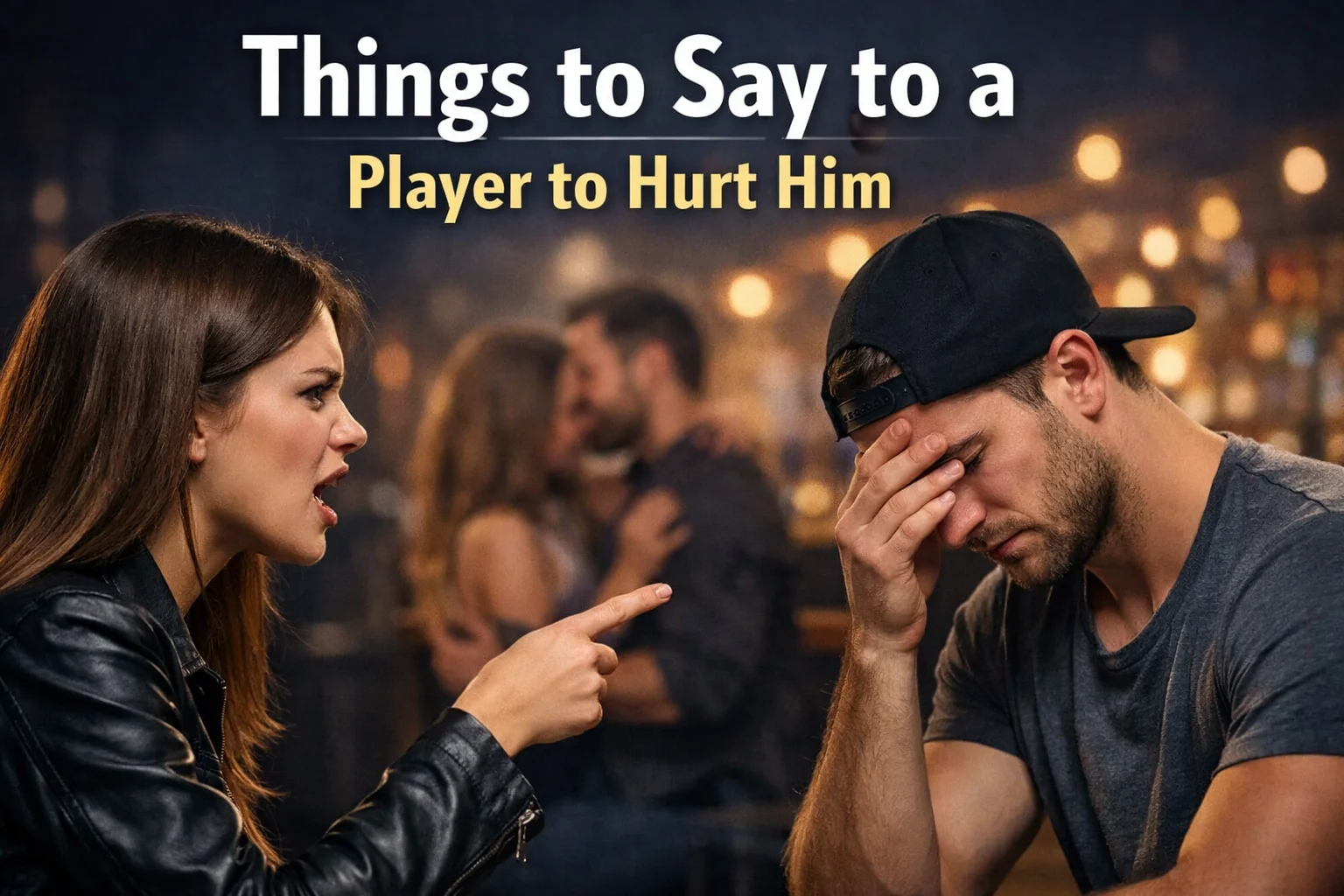
If you need lines to cut through someone’s game-playing, this list — 30 Things to Say to a Player to Hurt Him — gives direct, emotionally precise phrases that call out manipulation without descending into cruelty. These are designed to make a player feel seen and accountable: short, sharp, and honest.
Use them carefully — the goal is clarity and boundary-setting, not escalation. Each phrase below comes with a short scene, the meaning, the tone, a real-world example, and when it’s best used so you can choose the right weapon for the moment.
Another or Professional Way to Says “Player to Hurt Him”
- “You were practicing on me, not choosing me.” — Call out the player / stop game-playing
- “You love the idea of me more than the real me.” — Expose fantasy vs. reality
- “You collect people; you don’t build with them.” — Call out his pattern of collecting attention
- “You’re great at starting stories and terrible at finishing them.” — Point out flakiness
- “I was your warm-up act.” — Make him own emotional priority
- “You’re better at texts than at truth.” — Call out dishonesty by medium
- “You make promises like they’re accessories.” — Highlight broken promises
- “I wasn’t your secret; I was your back-up plan.” — Expose secrecy or hidden status
- “You date the chase, not the person.” — Point out motivation for pursuit
- “You’re allergic to us.” — Make his avoidance obvious
- “You think loyalty is boring; I think it’s everything.” — Contrast values
- “I was the one doing all the work while you collected highlights.” — Call out effort imbalance
- “You keep tabs, not ties.” — Expose superficial attention
- “You say ‘I’ll call’ like it’s a placeholder.” — Point out empty assurances
- “You measure affection by convenience, not consistency.” — Expose conditional love
- “You’re the plot twist, not the partner.” — Label unpredictability
- “You flattered me into trusting you — then used my trust.” — Point out exploitation
- “You date versions of people you’ll never keep.” — Call out repeat behavior
- “You’re allergic to responsibility but love the perks.” — Expose selfishness
- “You were always ‘maybe’ to me.” — Make uncertainty sting
- “You’re an expert at the chase, an amateur at the keep.” — Shame his inability to maintain
- “You treated my heart like a side quest.” — Reduce his actions to nonessential
- “Your apologies are rehearsed; I want change.” — Expose performative remorse
- “You made me proof that you could get what you wanted.” — Show he used you for validation
- “You keep rewriting the rules to suit you.” — Point out hypocrisy
- “You pick comfort over commitment every time.” — Expose pattern of avoidance
- “You were a headline, not a home.” — Contrast publicity with intimacy
- “You taught me my worth by showing me yours.” — Turn hurt into learning
- “You were loud in public and quiet in private.” — Call out performative love
- “You’ll always be good at beginnings; I want someone who’s good at staying.” — Final, decisive boundary
1. “You were practicing on me, not choosing me.” — Call out the player / stop game-playing
A rainy Friday. You realize every flirty text came when he had nothing better to do. You tell him this in a calm voice while packing your bag. He freezes — because you named the pattern he thought was invisible. The room grows quiet, and for once the chase loses its fun for him.
Meaning: He treated you as an option, not a priority.
Tone: Calm, factual, slightly disappointed.
Example: “I get that you like attention, but I wasn’t your practice round.”
Best use: When you’ve discovered a repeating pattern of casual text-only contact.
2. “You love the idea of me more than the real me.” — Expose fantasy vs. reality
You meet up after a week of mixed signals. He speaks like you’re a highlight reel, not a person with messy days. Saying this puts a mirror up: he’s in love with a version he invented, not the one sitting across from him. It lands because it’s true and hurts his ego — his fantasy is called out.
Meaning: He’s projecting an idealized image onto you.
Tone: Wry, slightly hurt, honest.
Example: “Stop dating your imagination; I’m here, flaws included.”
Best use: When he flirts with an idealized version of you, not your real self.
3. “You collect people; you don’t build with them.” — Call out his pattern of collecting attention
At a party, you notice how easily he flits from person to person. Later, you tell him this with a slow, steady voice. It stings because it’s accurate: he prizes quantity over depth. You’re not number 12 on a list — you’re the only one walking out.
Meaning: He treats relationships like trophies.
Tone: Matter-of-fact, cool.
Example: “I thought I was someone, not another thing to add to your shelf.”
Best use: When his history shows many short flings and no real commitment.
4. “You’re great at starting stories and terrible at finishing them.” — Point out flakiness
After another abrupt ghosting, you say this when he reappears. It lands because it frames his behavior as a consistent story arc he’s responsible for. He’ll feel exposed — the label “starter, not finisher” is uncomfortable.
Meaning: He abandons people when things get real.
Tone: Sharp with a hint of sarcasm.
Example: “You always begin chapters you don’t intend to end.”
Best use: When he repeatedly ghosts after promising more.
5. “I was your warm-up act.” — Make him own emotional priority
You confront him after learning he’s been dating others behind your back. Saying this strips glamour from the chase. Warm-ups aren’t main events — and he’ll know you noticed his hierarchy.
Meaning: You were played as temporary entertainment.
Tone: Cool, cutting.
Example: “Turns out I was the opening act, not the headline.”
Best use: When you find out he’s been keeping options open.
6. “You’re better at texts than at truth.” — Call out dishonesty by medium
He’s smooth in messages but evasive in person. Saying this during a face-to-face forces him to reconcile the difference between curated texts and messy real talk. It hurts because it undermines his confidence in his own charm.
Meaning: He avoids honest conversations live.
Tone: Lightly mocking, disappointed.
Example: “On your phone you’re brave; in real life, not so much.”
Best use: When he hides behind messaging rather than communicating.
7. “You make promises like they’re accessories.” — Highlight broken promises
You list the promises he kept and the ones he didn’t. He hears the weight of the ones he discarded. Comparing promises to accessories makes commitment look frivolous — and that hurts his image of himself as dependable.
Meaning: He treats commitments as optional.
Tone: Accusatory but composed.
Example: “You wore promises for show, then left them in the closet.”
Best use: After repeated disappointments and unmet commitments.
8. “I wasn’t your secret; I was your back-up plan.” — Expose secrecy or hidden status
When you discover he’s been secretive — maybe you found his hidden profiles or learned he lied about being single — delivering this line publicly or in a stiff conversation strips the glamour from secrecy. It’s humiliating because it reframes you from clandestine thrill to Plan B.
Meaning: He kept you hidden while he explored other options.
Tone: Resigned, cutting.
Example: “You didn’t introduce me because introductions complicate plans.”
Best use: If you learn you were deliberately hidden or lied about.
9. “You date the chase, not the person.” — Point out motivation for pursuit
You call him on his thrill-seeking when he confesses he likes the pursuit. Naming this takes the trophy out of winning you — it’s not flattering to be someone’s game. He’ll feel exposed for his motives, not his charm.
Meaning: He’s motivated by conquest, not connection.
Tone: Crisp, accusatory.
Example: “That rush you get? It’s from the hunt, not from me.”
Best use: When he admits he loves the chase.
10. “You’re allergic to us.” — Make his avoidance obvious
When he dodges responsibility and intimacy, a sharp line like this is memorable. It frames him like he physically rejects closeness. It sounds witty, but it cuts because it describes his consistent avoidance in a new, personal way.
Meaning: He avoids commitment or emotional closeness.
Tone: Wry, slightly mocking.
Example: “Every time things get real, you sneeze and leave.”
Best use: When he repeatedly avoids deeper connection.
11. “You think loyalty is boring; I think it’s everything.” — Contrast values
You say this after he brags about flirting freely. It shows you value different things and makes his behavior look immature. It’s effective because it frames moral difference, not just personal hurt.
Meaning: You and he have incompatible relationship values.
Tone: Firm, principled.
Example: “I want steady; you want variety — that’s the problem.”
Best use: When debating relationship expectations.
12. “I was the one doing all the work while you collected highlights.” — Call out effort imbalance
You detail the ways you showed up, and he’s left with no defense. Naming effort imbalance makes emotional labor visible and embarrassing. He’ll feel guilty for being passive while you were active.
Meaning: You invested; he didn’t.
Tone: Blunt, disappointed.
Example: “I scheduled, texted, showed up — you showed up when convenient.”
Best use: If you’ve been consistently more invested.
13. “You keep tabs, not ties.” — Expose superficial attention
He checks in sporadically — late-night likes and story replies — but never truly connects. Saying this makes his attention look performative, not real. It’s a short phrase with a clear sting.
Meaning: His interest is shallow and intermittent.
Tone: Cool, cutting.
Example: “You watch my life like a show, you don’t live in it.”
Best use: When his engagement is only surface-level.
14. “You say ‘I’ll call’ like it’s a placeholder.” — Point out empty assurances
When “I’ll call” becomes a pattern, use this line. It hurts because it reduces his words to a predictable script. You force him to own the emptiness of his standard lines.
Meaning: He uses comforting phrases without following through.
Tone: Literal, unimpressed.
Example: “Save me the ‘I’ll call’ — show up or don’t say it.”
Best use: After repeated no-shows or broken plans.
15. “You measure affection by convenience, not consistency.” — Expose conditional love
You describe how he’s affectionate when it suits him. That contrast shames him: his affection isn’t unconditional or steady. It’s powerful because it reframes love as conditional.
Meaning: His care depends on what’s easy for him.
Tone: Clear, indignant.
Example: “You’re affectionate when it’s convenient, absent when it’s not.”
Best use: When his kindness vanishes during difficulties.
Also Read This: 30 Flirty Responses to “Are You a Parking Ticket?”
16. “You’re the plot twist, not the partner.” — Label unpredictability
If his behavior is all drama and few roots, this line nails him. It’s pointed and clever, framing him as entertainment rather than support — which is humiliating if he wants credit for being exciting.
Meaning: He’s unpredictable and unreliable.
Tone: Sharp, slightly sarcastic.
Example: “I don’t want a surprise every week; I want steadiness.”
Best use: For someone who treats relationships like drama.
17. “You flattered me into trusting you — then used my trust.” — Point out exploitation
When he manipulates compliments into access, using this shows you noticed. It hurts because it turns his strategy back on him; charm becomes weaponized and now he’s called a manipulator.
Meaning: He used compliments to manipulate you.
Tone: Accusatory, wounded.
Example: “Your compliments bought your way in; they weren’t real.”
Best use: When charm masks manipulative behavior.
18. “You date versions of people you’ll never keep.” — Call out repeat behavior
You reference his history of short flings. Saying this in public or private shows you’ve seen the pattern and aren’t willing to be another temporary face. It strips away his illusion of uniqueness — he’s just repeating himself.
Meaning: He habitually moves on quickly.
Tone: Observational and cutting.
Example: “You pick people like props; they don’t last.”
Best use: When he has a predictable pattern of short relationships.
19. “You’re allergic to responsibility but love the perks.” — Expose selfishness
He wants the benefits—attention, companionship—without the obligations. Saying this makes his choices sound selfish and childish. It’s effective because perks without responsibility are socially frowned upon.
Meaning: He enjoys the good parts but avoids duty.
Tone: Blunt, scornful.
Example: “You want the fun parts and none of the follow-through.”
Best use: When he avoids consequences of his actions.
20. “You were always ‘maybe’ to me.” — Make uncertainty sting
When you’ve been in an ambiguous relationship, this line cuts because “maybe” is exactly the label that reduces a person’s worth. You’re telling him his indecision cost you dignity.
Meaning: He never committed fully.
Tone: Quiet, cutting.
Example: “I deserve a yes, not a string of maybes.”
Best use: For on-off or undefined relationships.
21. “You’re an expert at the chase, an amateur at the keep.” — Shame his inability to maintain
You highlight that excitement isn’t the same as sustainability. He’ll bristle because “keeping” is harder and more honest than chasing. You frame him as inexperienced with real relationship work.
Meaning: He can pursue but not sustain a real relationship.
Tone: Wry, disappointed.
Example: “You win people over, then you don’t play the long game.”
Best use: When he’s lively at the start, absent later.
22. “You treated my heart like a side quest.” — Reduce his actions to nonessential
This gamer metaphor works because it minimizes his importance in your life. It’s painful because it shows you recognize where you fell on his priority list — not main story, just something for fun.
Meaning: He didn’t treat the relationship as important.
Tone: Sarcastic, hurt.
Example: “I wasn’t the main story — I was the optional content.”
Best use: When his engagement is clearly low-priority.
23. “Your apologies are rehearsed; I want change.” — Expose performative remorse
If his “sorry” is always followed by the same behavior, call it out. People who rely on rehearsed apologies prefer short-term fixes to lasting change. This line forces a choice: act differently or stop apologizing.
Meaning: His apologies lack real follow-through.
Tone: Firm, no-nonsense.
Example: “Don’t say ‘I’m sorry’ unless you mean it enough to change.”
Best use: When apologies repeat without behavior change.
24. “You made me proof that you could get what you wanted.” — Show he used you for validation
You confront him with the idea that he took pride in “getting” you. That’s humiliating because it reduces emotional connection to ego. You weren’t a person to him — you were a trophy.
Meaning: He used you to boost his ego.
Tone: Cutting, disillusioned.
Example: “You loved showing me off more than being with me.”
Best use: When you feel manipulated for status or bragging rights.
25. “You keep rewriting the rules to suit you.” — Point out hypocrisy
He sets terms that always benefit him. Calling him out exposes dishonesty and shows you won’t be gaslit into accepting double standards. This one hits because it undermines his control.
Meaning: He changes expectations to avoid responsibility.
Tone: Direct, fed-up.
Example: “You decide what counts when it benefits you — that’s not fair.”
Best use: When he constantly shifts boundaries or standards.
26. “You pick comfort over commitment every time.” — Expose pattern of avoidance
If he chooses easy options when things require effort, this line names the cowardice. It’s painful because it suggests he values ease over building something real.
Meaning: He avoids the hard but meaningful parts of a relationship.
Tone: Stern, disappointed.
Example: “You take the comfortable exit instead of staying to fix things.”
Best use: When he repeatedly avoids effort in the relationship.
27. “You were a headline, not a home.” — Contrast publicity with intimacy
If he loves the show of the relationship (stories, tags) more than the substance, this phrase makes that public performance feel shallow. It hurts because it reframes his public image as hollow.
Meaning: He prioritizes appearance over genuine intimacy.
Tone: Sharp, revealing.
Example: “We were great on camera; not great behind the scenes.”
Best use: For relationships heavy on image and light on depth.
28. “You taught me my worth by showing me yours.” — Turn hurt into learning
This line is bittersweet: it points out his low standards while reclaiming your dignity. It stings because it implies he underestimated your value, and you saw it.
Meaning: His behavior taught you what not to accept.
Tone: Empowered, slightly scornful.
Example: “Thanks for the lesson — I won’t repeat it.”
Best use: When you want to end things and reclaim power.
29. “You were loud in public and quiet in private.” — Call out performative love
If his affection is performative, this line exposes the difference between showmanship and sincerity. It hurts because it implies manipulation for social credit.
Meaning: His public displays don’t match private care.
Tone: Accusatory, disappointed.
Example: “You liked the applause more than the actual person.”
Best use: When he’s more demonstrative in front of others than to you alone.
30. “You’ll always be good at beginnings; I want someone who’s good at staying.” — Final, decisive boundary
This sums up everything: you’re done with temporary thrills and want permanence. It’s decisive and clean — it forces him to choose where he stands. It hurts because it emphasizes his failure to be the consistent partner you deserve.
Meaning: You want consistency; he’s offered only starts.
Tone: Resolute, closing.
Example: “I’m choosing someone who shows up for the whole story — not just the first page.”
Best use: When you are ending things for good and want to be clear.
FAQs:
Q: Are these phrases abusive?
A: They’re direct and designed to set boundaries or expose patterns. They can feel hurtful because they call out behavior. Use them responsibly — the aim is accountability, not cruelty.
Q: Will saying these help the relationship?
A: Sometimes naming the problem wakes people up. Other times it confirms incompatibility. Use these lines to get clarity; don’t expect instant transformation.
Q: What if the player reacts angrily?
A: Stay calm, keep boundaries, and exit if you feel unsafe. If his reaction becomes aggressive, prioritize your safety and remove yourself.
Q: Can I soften these for a private conversation?
A: Yes. You can keep the core message but reduce the sharpness with more “I” statements (e.g., “I felt like I was a back-up, and that hurt”).
Q: How do I choose which line to use?
A: Match the line to the behavior. If he ghosts, use lines about starting vs finishing. If he flaunts you publicly but ignores you privately, use the public/private contrast.
Conclusion:
Using hurtful words is powerful — and with power comes responsibility. These 30 Things to Say to a Player to Hurt Him are meant to give you clear, precise language to call out manipulative patterns, reclaim your dignity, and set firm boundaries. Be intentional: aim for truth, avoid gratuitous cruelty, and choose your moment. You don’t need to prove anything to a player; you only need to protect your heart and make sure your next chapter is with someone who’s actually ready to stay.