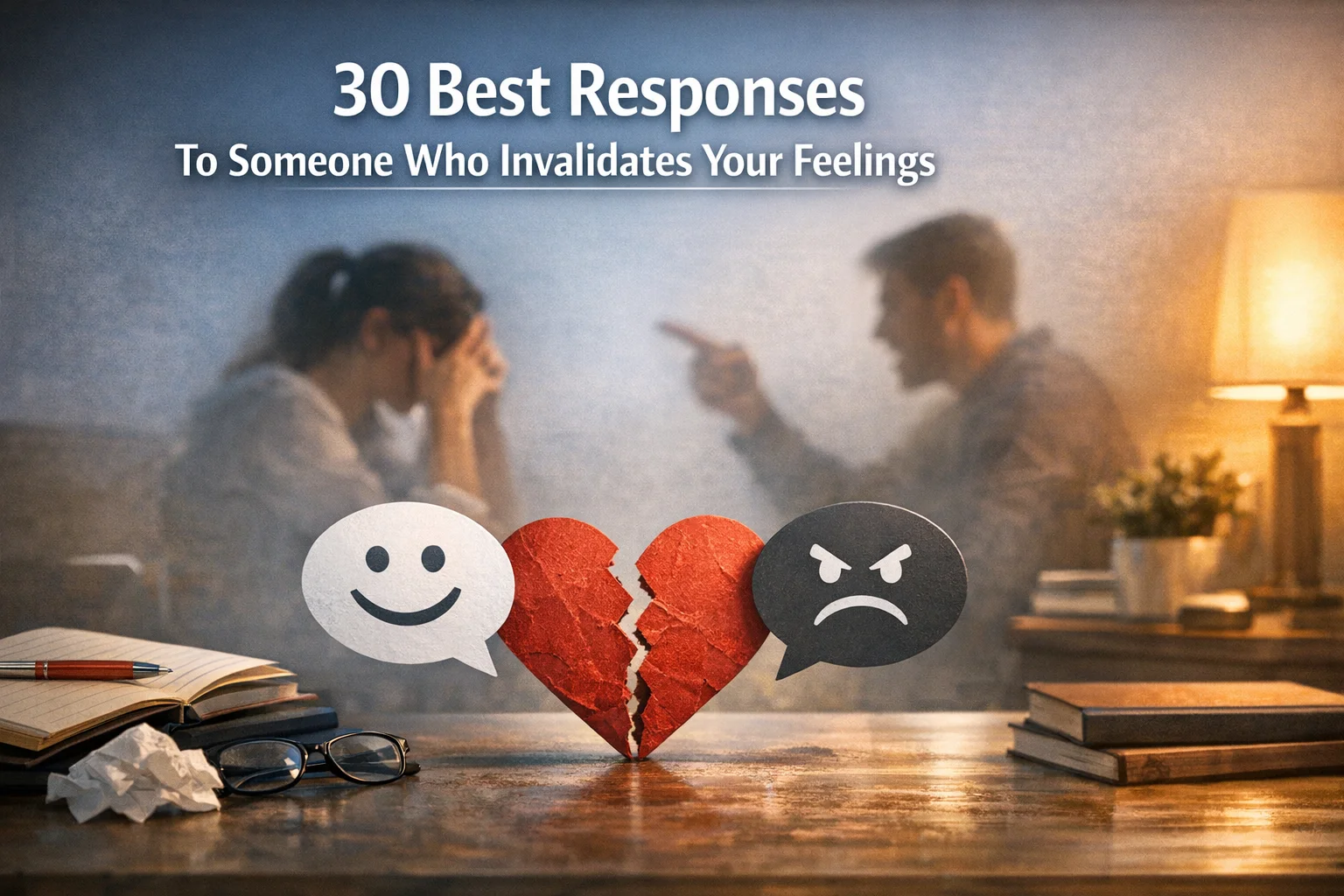
Facing a situation where someone invalidates your feelings can feel like navigating a stormy sea of emotions. The remark may be dismissive or minimizing, like “You’re over-reacting” or “Calm down, I was just joking!”—and it can leave your blood boiling while making you question the legitimacy of your emotions. Over the years, I’ve noticed that handling these moments with poise, self-assurance, and emotional intelligence is key. Responding to invalidation isn’t just about defending yourself; it’s an intricate dance of acknowledging your feelings while staying psychologically aware and maintaining peace in the interaction. By using a toolkit of practical, respectful, and assertive approaches, you can reclaim your emotional space and guide the conversation toward validation, not conflict.
Here are 30 Best Responses to someone who invalidates your feelings, presented as numbered responses with short, real-life context, story, or examples. Each is designed to empower you, helping you communicate with clarity, confidence, and empathy while preserving your self-respect. Key approaches include affirming your reality with “I”-statement-driven phrases like “I feel how I feel” or “My feelings make sense to me,” setting boundaries such as “I need you to hear me out, not fix it,” and tailoring your response depending on whether you’re dealing with friends, partners, family, coworkers, or strangers. This guide allows you to navigate dismissive, hurtful moments, unveil the impact of words, and explore ways to respond without losing peace or emotional safety, turning these experiences into beacons for healthier communication.
Another or Professional Way to Respond to Someone Who Invalidates Your Feelings
- I hear you, but my feelings are real.
- Please don’t tell me how I should feel.
- That response hurts me.
- I need you to listen, not lecture.
- I understand you disagree, but my feelings are valid.
- I’m telling you how I feel; please treat that with respect.
- I wish you could see this from my perspective.
- Your opinion matters, but so do my feelings.
- I don’t need validation from you to know what I feel.
- Can we pause? I’m feeling dismissed.
- I’d like to share why this matters to me.
- I’m not overreacting; this is important to me.
- I need emotional safety in this conversation.
- I’m sharing feelings, not blaming.
- That minimizes what I experienced.
- Please don’t compare my feelings to someone else’s.
- I’m surprised that you’d say that.
- I want to feel supported, not minimized.
- I value your perspective; please value mine.
- Stop telling me I’m dramatic.
- I’d rather we agree to disagree than dismiss each other.
- That feels like gaslighting.
- I’m going to step away until we can be respectful.
- Help me understand what you meant by that.
- I’m allowed to feel this way.
- That response makes it hard for me to open up.
- I’m telling you because I trust you.
- You don’t have to fix me—just listen.
- I’d like to set a boundary about how we talk.
- Thank you for hearing me.
1. “I hear you, but my feelings are real.”
A late-night text made Leila feel small; her friend replied with a shrug emoji and “it’s not a big deal.” Leila typed back calmly, “I hear you, but my feelings are real.” In that moment the other person paused, read it again, and apologized; the short message stopped escalation and invited respect. The line signals active listening while refusing erasure and models boundary-setting without aggression. It’s short, emotionally literate, and hard to argue with because it acknowledges the other person while asserting your inner experience.
Meaning: This response acknowledges the other person’s stance but affirms your emotional reality.
Tone: Calm, steady, non-confrontational.
Example: “I know you meant something else, but my feelings are real right now.”
Best Use: Use when you want to be heard and keep the conversation constructive.
2. “Please don’t tell me how I should feel.”
When Amir’s mother said, “You shouldn’t be upset about that,” Amir felt dismissed. He replied, “Please don’t tell me how I should feel.” The sentence created a soft but firm boundary; it made clear that emotions aren’t optional advice and invited the other person to stop prescribing feelings. It’s direct without attacking and often causes the invalidator to rethink their language because the phrasing calls out a common behavior rather than labeling the person.
Meaning: A direct boundary against emotional prescription.
Tone: Assertive and polite.
Example: “I appreciate your view, but please don’t tell me how I should feel.”
Best Use: Use with people who habitually minimize emotions (family, coworkers).
3. “That response hurts me.”
After a partner laughed off their partner’s anxiety as “drama,” Sara said simply, “That response hurts me.” The honesty pierced the dismissive shell and prompted the partner to ask, “Why?”—opening space for real conversation. Saying how the response affected you centers your experience and prevents the conversation from becoming a debate about who’s right. It’s effective because it frames the issue around the impact, which is hard to refute.
Meaning: States the emotional impact of the other person’s words.
Tone: Vulnerable, direct.
Example: “When you say that, it hurts me.”
Best Use: Use when you want to prompt empathy and reflection.
4. “I need you to listen, not lecture.”
During a heated family discussion, Khalid felt a lecture rather than support. He said, “I need you to listen, not lecture.” That request shifted the dynamic from instruction to presence. It clarifies your immediate need: being heard rather than corrected. Often people default to fixing rather than listening; this line helps redirect them gently but firmly.
Meaning: Requests attentive listening instead of unsolicited advice.
Tone: Firm, practical.
Example: “Right now I need you to listen, not lecture.”
Best Use: Use when someone responds with advice instead of empathy.
5. “I understand you disagree, but my feelings are valid.”
When someone counters your feelings with facts, it can feel invalidating. Maya said, “I understand you disagree, but my feelings are valid.” This combines acknowledgment with boundary—recognizing the other’s perspective while insisting your emotional response stands on its own. It’s especially useful in debates that drift into personal invalidation.
Meaning: Separates factual disagreement from emotional validity.
Tone: Respectful, firm.
Example: “You might not see it that way, but my feelings are valid.”
Best Use: Use in disagreements where facts are used to dismiss emotion.
6. “I’m telling you how I feel; please treat that with respect.”
When Javier’s coworker shrugged off his stress, Javier replied, “I’m telling you how I feel; please treat that with respect.” This framing moves the conversation from argument to request. It asks for basic interpersonal courtesy and sets a standard for how you want to be treated moving forward. The sentence is formal enough for workplace settings yet human enough for personal relationships.
Meaning: Calls for respectful treatment of expressed emotions.
Tone: Formal, boundary-setting.
Example: “I’m sharing my feelings—please respect them.”
Best Use: Use at work or with acquaintances where decorum helps maintain boundaries.
7. “I wish you could see this from my perspective.”
When an old friend minimized Nora’s grief, she said, “I wish you could see this from my perspective.” That gentle appeal invites perspective-taking rather than defensiveness. It conveys longing for empathy and can help the other person mentally step into your shoes. The phrase is non-accusatory and opens a bridge that emotional invalidation often blocks.
Meaning: Invites empathy and perspective-taking.
Tone: Wistful, invitational.
Example: “I wish you could see this from my side.”
Best Use: Use when you want to encourage understanding without confrontation.
8. “Your opinion matters, but so do my feelings.”
When someone juxtaposed their opinion as superior to your feelings, this line cuts through the hierarchy. Sam said, “Your opinion matters, but so do my feelings,” and it balanced respect for viewpoint with self-respect. It prevents conversations from becoming a tug-of-war over whose reality is more legitimate and insists emotions deserve equal weight.
Meaning: Balances mutual respect between opinion and emotion.
Tone: Equitable, steady.
Example: “I value your opinion; I also value my feelings.”
Best Use: Use when debates risk dismissing emotional responses.
9. “I don’t need validation from you to know what I feel.”
When validation is withheld, the impulse to seek approval can intensify hurt. Layla replied, “I don’t need validation from you to know what I feel,” reclaiming internal authority over her emotions. This is an empowering statement that reduces dependence on the other person’s approval and can defuse manipulative invalidation tactics.
Meaning: Reclaims personal authority over one’s emotions.
Tone: Empowered, calm.
Example: “I’m secure in how I feel; I don’t need you to validate it.”
Best Use: Use when someone tries to gatekeep or upend your emotional reality.
10. “Can we pause? I’m feeling dismissed.”
During an argument that escalated quickly, Omar said, “Can we pause? I’m feeling dismissed.” The request to pause creates breathing room and prevents reactive replies that make things worse. It signals you’re engaged but need a break to avoid spiraling. Often a short pause is all that’s needed to reset tone and restore mutual respect.
Meaning: Requests a temporary break to avoid escalation.
Tone: Calm, self-regulating.
Example: “Let’s pause for a moment; I’m feeling dismissed.”
Best Use: Use during heated exchanges to protect emotional safety.
11. “I’d like to share why this matters to me.”
When someone minimizes a concern, offering context can shift their view. Hana said, “I’d like to share why this matters to me,” and then explained the backstory that made the issue painful. Providing context humanizes feelings and helps the other person see deeper causes. It’s an educational move that often transforms invalidation into insight.
Meaning: Offers context to promote understanding.
Tone: Explanatory, patient.
Example: “Can I explain why this affects me so much?”
Best Use: Use when the other person lacks necessary context.
12. “I’m not overreacting; this is important to me.”
When accused of overreacting, Nat stated, “I’m not overreacting; this is important to me.” That line refuses the diminishment implied by “overreact.” It stands firm about the interior significance of the issue without escalating to personal attack. It also signals that your emotional threshold should be respected.
Meaning: Rejects the label of overreaction and affirms importance.
Tone: Firm, self-assured.
Example: “This matters to me, and it isn’t an overreaction.”
Best Use: Use when someone dismisses your feelings as exaggerated.
13. “I need emotional safety in this conversation.”
Sara told a friend, “I need emotional safety in this conversation,” when humor turned into belittling. Naming the need for safety sets a standard: no mocking, sarcasm, or gaslighting. It’s a way to request a safe container for honest talk and is especially useful with those who unintentionally cross emotional boundaries.
Meaning: Requests a safe, respectful conversational environment.
Tone: Secure, boundary-aware.
Example: “For me to continue, I need emotional safety right now.”
Best Use: Use when interactions become invalidating or mocking.
14. “I’m sharing feelings, not blaming.”
In a tense moment, Fiona clarified, “I’m sharing feelings, not blaming.” This reduces defensive reactions because it makes your intent clear: you’re expressing your interior state, not assigning guilt. It can lower barriers to listening and prevents the other person from turning the conversation into a counterattack.
Meaning: Distinguishes emotional expression from accusation.
Tone: Clarifying, non-threatening.
Example: “This is how I feel; I’m not blaming you.”
Best Use: Use to prevent escalation into mutual blaming.
15. “That minimizes what I experienced.”
When someone shrugged off a traumatic memory, Rina said, “That minimizes what I experienced.” The phrasing calls out minimization behavior directly and prompts reflection. It converts a vague feeling of dismissal into a clear statement about the other person’s action, encouraging accountability and repair.
Meaning: Identifies and calls out minimizing behavior.
Tone: Direct, corrective.
Example: “Saying that minimizes what I experienced.”
Best Use: Use when dismissal erases the significance of your experience.
Also Read This: 30 Best Replies When Someone Says You Inspire Them
16. “Please don’t compare my feelings to someone else’s.”
Comparisons often invalidate because they rank experiences. When Ahmed’s disappointment was compared to someone “worse off,” he responded, “Please don’t compare my feelings to someone else’s.” This asks the speaker to avoid relativizing pain and to acknowledge the uniqueness of each person’s emotional landscape.
Meaning: Rejects relativizing feelings through comparison.
Tone: Firm, gentle.
Example: “I’d prefer not to compare—this is how I feel.”
Best Use: Use when someone uses comparison to dismiss your emotion.
17. “I’m surprised that you’d say that.”
A short expression of surprise can be disarming. When Claire heard dismissal from a close friend, she said, “I’m surprised that you’d say that.” The statement prompts curiosity and self-check in the other person and often elicits a pause or retraction. Surprise is less confrontational than accusation and can lead to a quicker repair.
Meaning: Signals unexpected invalidation and invites reconsideration.
Tone: Measured, questioning.
Example: “I’m surprised you’d respond that way.”
Best Use: Use to provoke reflection without aggressive confrontation.
18. “I want to feel supported, not minimized.”
When support is needed, specify it. Farah said, “I want to feel supported, not minimized,” and the explicit request nudged her partner toward empathy. Naming the need for support clarifies how the other can help and prevents vague disappointment. It’s a practical guide for building supportive interactions.
Meaning: Expresses a specific relational need for support.
Tone: Clear, inviting.
Example: “Right now I want support instead of being minimized.”
Best Use: Use when you need concrete emotional support from someone close.
19. “I value your perspective; please value mine.”
In conversations where voices feel unequal, Noor said, “I value your perspective; please value mine.” The reciprocal framing appeals to fairness and mutual respect. It’s less likely to provoke defensiveness because it starts with respect before requesting the same in return.
Meaning: Asks for reciprocal respect between perspectives.
Tone: Equitable, diplomatic.
Example: “I respect you—please respect my feelings too.”
Best Use: Use when seeking parity in dialogue with peers.
20. “Stop telling me I’m dramatic.”
Sometimes bluntness is necessary. When someone repeatedly labeled her as “dramatic,” Ayesha said, “Stop telling me I’m dramatic.” The demand directly addresses a recurring invalidation and sets a strict limit. Use sparingly and only when softer phrasing has failed, as its bluntness can provoke defensiveness if misapplied.
Meaning: Directly halts a recurring invalidating label.
Tone: Firm, boundary-enforcing.
Example: “Please stop calling me dramatic.”
Best Use: Use when labels are repeatedly used to dismiss you.
21. “I’d rather we agree to disagree than dismiss each other.”
When debates threaten to invalidate feelings, Rashid offered, “I’d rather we agree to disagree than dismiss each other.” This path toward mutual tolerance preserves relationships by trading winning for coexistence. It’s elegant because it refuses erasure while avoiding a drawn-out argument.
Meaning: Prioritizes mutual respect over being right.
Tone: Conciliatory, wise.
Example: “Let’s agree to disagree rather than dismiss one another.”
Best Use: Use when preserving the relationship matters more than convincing.
22. “That feels like gaslighting.”
When small lies or re-frames consistently erased facts, Leena said, “That feels like gaslighting.” Naming manipulative dynamics can be clarifying and powerful—if accurate and measured. Use this when patterns of denial or distortion are present, and be prepared to explain why you feel that way.
Meaning: Labels manipulative invalidation patterns.
Tone: Serious, explanatory.
Example: “When you change the story like that, it feels like gaslighting.”
Best Use: Use when you experience ongoing denial or distortion.
23. “I’m going to step away until we can be respectful.”
Setting a consequence preserves dignity. When an argument turned demeaning, Bilal said, “I’m going to step away until we can be respectful.” Leaving temporarily protects emotional health and signals you won’t tolerate ongoing invalidation. It’s a boundary with action—clear and effective.
Meaning: Enacts a boundary by creating space when respect is absent.
Tone: Determined, self-protective.
Example: “I’m stepping away until this is respectful.”
Best Use: Use to protect yourself when patterns of invalidation continue.
24. “Help me understand what you meant by that.”
Curiosity can defuse judgment. When a dismissive remark landed wrong, Saba responded with, “Help me understand what you meant by that.” The question invites clarification and often reveals that the speaker didn’t intend harm. It models curiosity over accusation and opens room for repair.
Meaning: Invites clarification rather than assuming malicious intent.
Tone: Curious, open.
Example: “Could you explain what you meant—I want to understand.”
Best Use: Use when you suspect misunderstanding rather than malice.
25. “I’m allowed to feel this way.”
When emotions are questioned, Noor declared, “I’m allowed to feel this way.” The statement reclaims emotional sovereignty. It’s simple, hard to argue against, and affirms a basic human truth: feelings are not a permission-based system. It’s empowering and disarms attempts to police emotion.
Meaning: Asserts the right to emotional experience.
Tone: Steady, assured.
Example: “I am allowed to feel what I feel.”
Best Use: Use when someone suggests you have no right to your emotions.
26. “That response makes it hard for me to open up.”
When someone’s dismissal shut down vulnerability, Tariq said, “That response makes it hard for me to open up.” The sentence links behavior to relational consequence: if you invalidate me, I won’t share. It’s useful to motivate change in partners or friends who value connection but lack awareness of their impact.
Meaning: Connects invalidation to reduced intimacy and trust.
Tone: Honest, relational.
Example: “When you say that, I don’t feel safe opening up.”
Best Use: Use with people whose behavior you want to change to preserve closeness.
27. “I’m telling you because I trust you.”
When betrayed by dismissive reactions, Amna reminded the person, “I’m telling you because I trust you.” This frames your disclosure as an act of vulnerability, making the invalidation more poignant and harder to dismiss. It often prompts remorse or at least reflection.
Meaning: Highlights vulnerability and the emotional cost of dismissal.
Tone: Vulnerable, sincere.
Example: “I shared this because I trust you—please don’t dismiss it.”
Best Use: Use when a trusted person responds coldly or flippantly.
28. “You don’t have to fix me—just listen.”
Fixer tendencies can feel invalidating. When someone immediately jumped to solutions, Meera said, “You don’t have to fix me—just listen.” That line frees the other person from the pressure to solve while centering the relational need for presence. It’s clarifying and often relieves the listener’s urge to perform.
Meaning: Requests presence over problem-solving.
Tone: Calm, instructional.
Example: “Right now, I need you to just listen, not fix.”
Best Use: Use when someone’s helpfulness feels like dismissal.
29. “I’d like to set a boundary about how we talk.”
When patterns repeat, formal boundary-setting is necessary. Karim said, “I’d like to set a boundary about how we talk,” and then specified unacceptable language. This formal approach is best for chronic invalidation. It sets expectations and consequences, helping protect emotional wellbeing over time.
Meaning: Establishes a clear conversational boundary and expectations.
Tone: Formal, decisive.
Example: “I won’t accept belittling language—please don’t speak to me that way.”
Best Use: Use for repeated or chronic invalidation.
30. “Thank you for hearing me.”
When a conversation shifts toward validation, end with gratitude. After a hard talk, Zara said, “Thank you for hearing me.” This reinforces positive behavior and encourages future listening. It’s brief, reinforces repair, and models reciprocal respect—closing the loop on emotional work.
Meaning: Reinforces and rewards empathetic listening.
Tone: Appreciative, reinforcing.
Example: “Thanks for taking the time to hear me.”
Best Use: Use to affirm constructive responses and strengthen relationship patterns.
FAQs
What does it mean when someone invalidates your feelings?
When someone invalidates your feelings, they dismiss, minimize, or ignore your emotions, often making you feel unheard or unimportant. Common phrases like “You’re over-reacting” or “Why are you so sensitive?” can sting deeply and leave your self-respect challenged. Recognizing this is the first step to responding with poise and emotional intelligence.
How can I respond without escalating conflict?
You can respond calmly using “I”-statement-driven phrases like “I feel how I feel” or “My feelings make sense to me.” This approach asserts your reality while remaining respectful and avoids escalating conflict, keeping communication healthy and constructive.
Should I always confront someone who dismisses my emotions?
Not necessarily. The response depends on the person and situation. Sometimes, setting a boundary like “I need you to hear me out, not fix it” is enough. Other times, it may be wiser to seek emotional safety by stepping away until a calmer conversation is possible.
Can these responses work with strangers or coworkers?
Yes. The 30 best responses are designed to be tailored for friends, partners, family, coworkers, or strangers. Using short, assertive, and empathetic statements helps you maintain professionalism while still affirming your feelings.
How do I maintain my peace after feeling invalidated?
Focus on acknowledging your own emotions and reclaiming your emotional space. Journaling, self-reflection, or talking to a supportive friend can help. The key is preserving your peace, knowing your feelings are valid, and not seeking approval from someone who dismisses you.
Conclusion
Handling situations where someone invalidates your feelings is never easy, but learning to respond with confidence, empathy, and clarity can transform these moments into opportunities for self-respect and healthy communication. By using assertive, “I”-statement-driven responses, setting boundaries, and staying emotionally aware, you can reclaim your emotional space while maintaining peace and grace. Remember, your feelings are valid, and choosing the right approach—whether with friends, family, coworkers, or strangers—helps you navigate conflict, preserve relationships when possible, and protect your emotional safety without losing self-assurance.